Ben Reilly Happens While You're Busy Making Other Plans
Showing posts with label Superman II. Show all posts

Thursday, October 20, 2011

Supergirl #2: A Symphony of Cartoon Violence

Jack Kirby once said, "There is something stupid in violence as violence."

On the surface, it seems odd to attribute that argument to a man who was arguably the master of comic book violence. Kirby's characters punch, kick and laser blast their way through life with passionate intensity. When his protagonists come to blows, jaws don't shatter. Worlds do.

But think about what Kirby was really saying. If you get into a barfight, you're likely to lose a molar. If you get into a fight with Dr. Doom or Darkseid, you're likely to lose a moon. Kirby's style isn't violence or even hyper-violence, it's heightened reality. Kirby would go on in the same interview to compare it to dance, with himself playing the role of choreographer.

Now on to Supergirl #2, where you'll get exactly what the cover promises. Supergirl decks Superman. Repeatedly. She kicks him some, too, and then tosses him around like a ragdoll by his cape. Scarcely a page goes by where Superman doesn't learn an important lesson about underestimating girls in new and painful ways. It's all in good fun, and it reminded me a lot of the Kryptonian slugfest from Superman II. There's something undeniably catharctic about watching gods and goddesses go into Wrestlemania mode.

"Do you smell what the House of El is cooking?"

It would be easy to criticize this as empty filler, but I can't. And it's not just because it's one of the most dynamic and beautifully illustrated action comics I've ever read. Comic book slugfests, like dance routines and wrestling matches, ultimately depend on the audience's investment.When you're plugged into the characters, a slugfest is really the manifestation of something much deeper. Every punch is another peak or valley in an emotional roller coaster ride. Supergirl #2 isn't violence as violence, it's a symphony.

I read one online criticism that Supergirl is aimed at the lowest common denominator, which simply doesn't ring true for me. On the contrary, it's a very intelligent comic that speaks to the reader in the most direct way possible. We open on Kara babysitting her infant cousin Kal-El. She's about to undergo the Kryptonian rite of passage, and she's nervous. She finds solace in her cousin's innocence. She hopes he doesn't grow too fast.

Then we flash forward to the present, which is only three days' time as far as Kara is concerned. She's inexplicably arrived on an alien world with strange new powers, and that's not even the worst of it. Her innocent baby cousin has suddenly rematerialized as the voice of age and experience. She's lost her bearings in every possible way.

As I read this comic to my daughter, we talked about how even heroes are scared of change. It's something that clicked for both of us in spite of the age gap. If you don't believe time can suddenly go as wonky for you as it did for Supergirl, just wait until the first time one of your children corrects you...and they're right. I'm getting advice about everything from video games to my writing from the kids these days, and I hope I'm smart enough to listen.

So a big thanks goes out to the creative team on Supergirl for not just making a comic, but creating a shared family experience. These guys are clearly smart enough to understand that we often come to superhero comics for the epic fights, but we stick with them because they mirror the human experience. And that puts them in the esteemed company of artists like Jack Kirby...

...and Beethoven.

Wednesday, October 6, 2010

"The Future in the Instant..."

Will Leitch has an interesting article up about Zack Snyder directing the new Superman film. Among other things, he speculates why Hollywood hasn't been able to make Superman work since Superman II:

Superman projects have vexed filmmakers as varied as Tim Burton, Kevin Smith, McG, J.J. Abrams, and Brett Ratner. The main problem with "Superman" is that we have turned into more of an antihero culture. We like Batman because he's human and flawed and full of rage and guilt. We like Tony Stark because he's selfish and vain and a party guy.


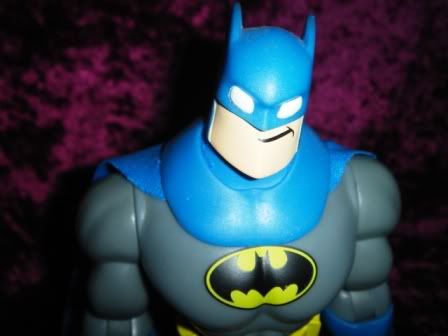
RAGE!! Because sculpted, plastic and filled with joy never caught on.

I think Leitch's argument, while thoughtful, is flawed on several counts.

For one, I object to his definition of antihero. I don't think it's "wrong," it's just not very accurate or useful in this context. Antiheroism is relative to the values of the community being represented. Wayne might be bitter and Stark's an alcoholic, but they still embrace traditional superhero values. They seek noble ends like justice and redemption. And while they push boundaries, they rarely step outside them.

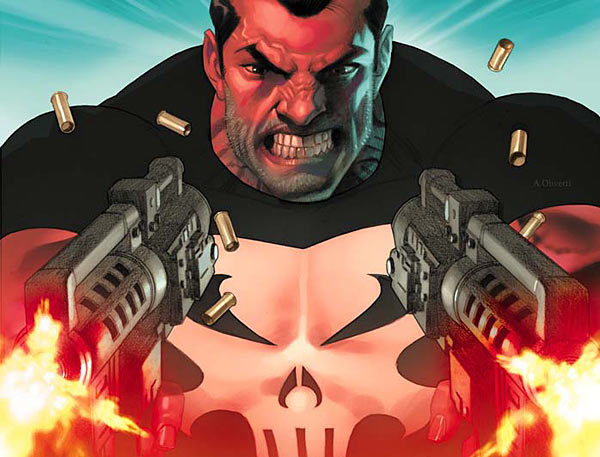
If you want a more accurate representation of antiheroes, I'd look to the Punisher and Deadpool. Punisher works outside the boundaries and Deadpool doesn't even acknowledge them. Anger, guilt and womanizing hardly compare to unrelenting homicide and madness. If they're all lumped together under the heading of "antihero," the terminology is taxed to the point of irrelevance.

"Tony didn't say anything about a cover charge!!!"

If Mr. Leitch means only to say that we like flawed heroes, that's been true at least as far back as Moses, and it was equally true of Christopher Reeve's Superman. His motives, while pure, are still mixed. He rebelled against his father's commandment not to reverse time because of his obsessive devotion to Lois, then turned his back on humanity for the same reason in the second film. This doesn't make him bad by any stretch of the imagination, but it does highlight how we tend to pass over Superman's flaws even when they're as pronounced as Batman's.

Leitch goes even further:

Superman is, by his very design, perfect and cheesy - he's a relic, Ward Cleaver in a blue skintight suit.

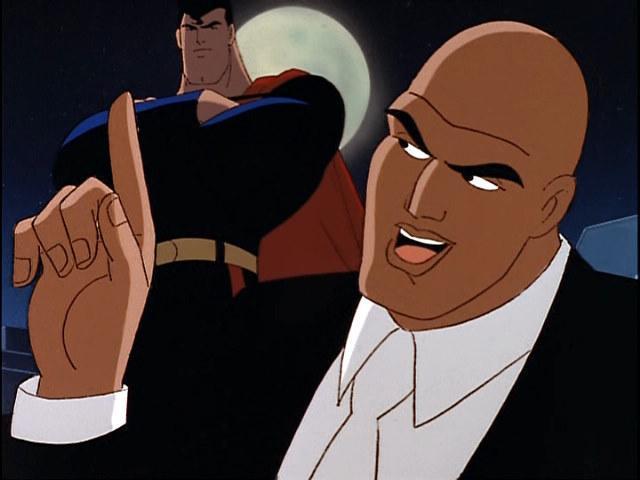
"Golly, Lex, I don't know. How can we hold Metropolis hostage when we promised Superman we'd do our homework?"
 I think Leitch is confusing perfection and idealism. Perfection is essentially completion or fulfillment. Saying we can attain perfection (Idealism) isn't the same as being perfect. By that same token, Superman can't be perfect until we're perfect, because he exists to remind us we have a destiny. Yet Veitch's Superman seems indelibly linked to the past rather than the future:
Singer attempted to capture that naïveté and bring it to today, but his Metropolis seemed as steeped in the '50s as the Steve Reeves films were. The reason the first two "Superman" films worked was that they were rooted in a recognizable place: Metropolis was late-'70s New York City, with all the grime and cynicism that came with it. Superman was an alien (he's the one who was out of place), an actual hero here to save the day, to give everyone faith again. To believe a man can fly, you must at first believe a man cannot.

I'm agreed with Veitch that Superman's faith in humanity is the root of his alienation. That's why Superman ultimately comes into conflict with Luthor, who sees Metropolis and humanity as mere extensions of himself. If Superman were half the relic Veitch thinks him, Luthor wouldn't feel so threatened. But Luthor understands what even Metropolis can't, because he fears it. Luthor has always believed a man can fly, which is why he devotes himself to clipping humanity's wings. And he knows where Superman really hails from: the future.


Lex Luthor just became irrelevant.
One of my favorite lines from Macbeth is, "Your letters have transported me beyond this ignorant present, and I now feel the future in the instant." Superman is Lex Luthor's window into a future where power struggles are obsolete. Lady Macbeth goes mad because she cannot help but bring the future to pass; Luthor because he cannot hold it back.

If Snyder wants to make Superman work, I think he needs to tap into "The Man of Tomorrow" vibe. That's been critical to most incarnations of Superman, but the one we're most familiar with is Donner's. His Superman can't be with Lois because it's still Today, which makes their relationship tragic and uplifting all at once. It's a metaphor for where humanity finds itself now, where we've always found ourselves, somewhere between the Fall and Redemption, Impossibility and Infinity.

When the time comes to bridge that gap in Hollywood...