Ben Reilly Happens While You're Busy Making Other Plans

Thursday, October 13, 2011

Comics Should Be Better Than Good, They Should Be "Disposable"!

Socrates argued that learning is really the art of remembering what we already knew. With that in mind, DC's New 52 is reminding me of some basic truths I once took for granted. One of the first things that jumped out at me about the relaunch was the compressed storytelling. The issues I read were compelling from start to finish, and left me wondering what would happen next.
If it seems redundant to suggest that comics should keep a reader's attention, well, it probably is. It's like saying you win football games by scoring more points than the opposing team. But that would be forgetting that the final score doesn't tell the whole story. A football game isn't just about numbers, it's an experience. There's nothing particuarly satisfying, for instance, about a football game where no touchdowns are scored. And it occurs to me that DC and Marvel have been playing the kind of ball where they're okay with never making it to their own end zone. It feels like the past ten years is Marvel bragging about winning the Superbowl 2-0 with a last minute safety, and DC bragging about what a close game it was.
Time will tell whether Dan Didio will pull off the most impressive upset since Image and Dark Horse challenged the Big Two, or if he's just rearranging deck chairs on the Titanic. But one thing seems abundantly clear. He's finally come to play ball.
So back to Comics Storytelling 101. What did I learn--i.e. remember--from the first month of DC's New 52?
Comics are disposable.
It seems to run counterintuitive to not just where comics are going, but where pop culture is as a whole. We've entered the so-called "age of availability." Nearly any television show that ever had a decent following is now or soon will be collected in its entirety on DVD. Better still, they're often available through internet streaming services like Netflix. I cannot tell you how much joy it brings me to rediscover my childhood by having Spider-Man and His Amazing Friends and The Cosby Show available at the click of a button. The same can be said for the way Marvel and DC are collecting my favorite 80s and 90s stories faster than I can afford them. But it's worth noting that the ten to twenty year gap from first run to collection built my anticipation, whereas that gap has been closed in modern times. Today's comic will be in trade within the year.
I think there's a few things to be said for this trend. First off, writers and artists cannot help but have a more oppressive sense of self-awareness about their work than they did in the 50s through the 90s. There was a growing awareness during that period that really good work might be collected (i.e. The Marvel Masterworks hardcovers) or make it to sydnication, but now we all know that bad work will be, too. The collections are being prepped before the popularity or quality of your work can even be appraised. If it's bad, its glorious badness will not be dropped as soon as the next batch of comics comes out, it will be enshrined.
The upshot of this is that artists no longer crank out work with the raw vitality that made Jack Kirby a star. Of course, I should be cautious not to romanticize the kind of conditions Kirby worked under. The volume of his work speaks to his unparallelled genius, but it probably says just as much about his genuine struggle to make ends meet in a sweat shop environment. But Kirby's work not only holds up to virtually every 'modern' standard you can throw at him, it's still as exciting, as vital, as relevant as ever.
If you want proof, look no further than DC's new OMAC series by Dan Didio, Keith Giffen and Scott Koblish. It's the most refreshing monthly I've read in years, and that's because it takes its cues from Kirby rather than Miller and Moore. Giffen and Koblish channel Kirby's art beautifully, but the comparison runs much deeper. You'll quote lines like "I'm a Build-A-Friend, and you are no friend of mine!" or "OMAC-tivate!" from sheer joy, and not out of any twisted obligation to prove that comics aren't 'just for kids.'  It's a work that's clearly written for the moment, and that's how Kirby won history.

Which brings me to my second point. Disposability is about urgency. The Watchmen model is devoted to the comics you should read, but the Kirby template is all about the comics you must read.
I want to read OMAC, and I don't want it in trade. I want it now. I can say the same for more DC books than I can afford at the moment. Urgency is exciting and it's contagious. If I don't watch television and you try to win me over, then giving me a Cheers DVD sends the wrong message. So why are we still passing off Watchmen and Year One to potential comic readers?  It says the best is behind us, that the conversation is over and we're all just biding our time until something else really good comes along. And if I'm an outsider I'm thinking, "Wake me up when you get there, and then we'll talk."
We sometimes forget that real evangelism comes from a place of love, not obligation. It's the former alcoholic with the light in his eye telling you how God saved his life, not the guy complaining about going to another potluck this Sunday, threatening you with hell or falling back on the "because that's the way it's supposed to be." The industry doesn't need doomsday prophets or the wait and see crowd. It needs evangelists, enthusiasts, people who simply cannot keep the joy of comics to themselves.

So thanks to DC for reminding me what it means to measure out the week as the distance from one Comic Book Wednesday to the next.

Friday, January 14, 2011

Spider-Man's Got a New Set of Threads

No, I'm not talking about Spidey's Tron suit in Dan Slott's "Big Time" arc.

I mean this, the first full shot of Andrew Garfield in costume for the upcoming Spider-Man film franchise reboot:


This photo excites me for several reasons.

First off, the reboot design doesn't have the texture issues from the Raimi films. It's slicker and works well with Garfield's frame. Speaking of which, Garfield looks more like the skinny, disillusioned kid from Queens than an athlete in nerd's clothing.

And last but not least, the photo is evocative. It speaks volumes about this sheltered kid who's suddenly forced to grow up far too fast. Until something proves otherwise, I'm convinced the creative team behind the new film "gets" Peter Parker.

Saturday, December 18, 2010

Merry Christmas

I'll be minimizing my internet activities in the following week to clear my mind and meditate on the holiday, but not before I wish everyone who follows my blog a very merry Christmas.

All the Best,

David

Friday, November 26, 2010

ASM 649: BND 2.0?

Amazing Spider-Man #649 cover by Humberto Ramos

On the whole, the BND era of Spider-Man was a personal disappointment.

Don't get me wrong. The stories were rarely bad, sometimes brilliant, but never consistent. It felt more like several loosely connected miniseries rolled out consecutively than Amazing Spider-Man. You could rarely trust the good or bad developments to go anywhere. The most apparent evidence? After going to devlilish extremes to remove the marriage, Peter Parker's romantic life went virtually nowhere for three years. With the thrice-monthly format, that's closer to nine years worth of ASM where nothing came of Peter's single status. So there's a bit more than passing-of-the-torch symbolism involved in the fact that Peter could only get together with Carlie in the final BND era story.

I was already predisposed to prefer one writer per title, so I was excited by the news that Dan Slott would be the sole writer of a twice-monthly ASM. The buzz surrounding Slott's BIG TIME arc only fed my excitement much more. And for anyone who's had the privilege of chatting with Dan online, it's pretty clear just how excited he is about this gig. You want someone writing ASM who has dreamed about this their whole life. (Now if we could just get Mark Waid on Superman, but that's a different story...)

So even before the first issue of BIG TIME hit stands, I really felt as though Slott's run would be much closer to what Marvel originally promised with BND: a back-to-basics fresh start. I'd like to say I wasn't disappointed with Slott's first issue, but I can't.

The $%^ thing sold out.

But hey, I'm a charitable guy. I'll take a hit for the team if it means that ASM could be Marvel's flagship title again during my lifetime. On a related note, I couldn't find a copy of Spider-Girl #1 either. Good news for Dan Slott and Paul Tobin, bad news for me.

Luckily, I was able to snag a copy of ASM 649 yesterday, and it was....yeah, I'm not beneath going for the cheap pun. Amazing Spider-Man...feels amazing again. Or at least this issue did.

So here's why I think Slott's run is so promising, based on what little I've seen:

1. Big Ideas. Slott's wanted to write ASM since before he was born, and he's reportedly got notebooks full of plots. So Slott just might be attached to ASM for the rest of his natural life, and he could conceivably be a co-plotter years after he's shuffled off this mortal coil. In two issues, Slott has given Peter a really cool job as a scientist, brought the Bugle back into play under the direction of Robbie Roberston, returned the Kingpin to Spider-Man's world, given us the return of the Hogoblin, and then something really wild. We're only a little ways in, but I'm genuinely excited (and intrigued) for the first time in a while.

2. Supporting Cast. Slott has utitlized so many cast members in such a short amount of time that I won't even try to summarize it. Suffice to say the supporting cast is not only a nice blend of new and old, but they genuinely feel connected again. Norah Winters is dating Randy Robertson, but Phil Urich is back and he's got his eye on her, too. And he's just a tad...well, he's got issues. That's just one example of how Slott is making Spider-Man's world a tangled web again, and I love it.

3. Bang for Buck. Remember the old comics, where characters had a lot of interaction, and panels were crammed full of witty dialogue? And it took you more than five minutes to read it, and you could it read it twice and pick up on stuff you'd missed the first time? Yeah, good times, and by good times I mean yesterday when I read ASM 649.

It's still early in Slott's run, but it looks as though we finally got our Brand New Brand New Day.

Friday, October 8, 2010

$#*! My Dad Says: "Sooner than Later"

Last night's $#*! My Dad Says featured a recurring punchline that's relevant to every new show's attempt to find itself: Ed likes things sooner than later. Viewers do, too, and that's why a show only has so long to prove itself. If last night's episode is any indication, audiences won't have to wait any longer.


Last week I talked about some of the problems the show needed to overcome. It's been enjoyable, but uneven at best, a show that felt more like the sum of its parts than something whole. The takeaway moments tended to call attention to themselves rather than building to a satisfying resolution. It's all symptomatic of the show's seeming reliance on Shatner to carry it. The scripts were generic, if decent, and the chemistry between Shatner and Sadowski was practically nonexistent. I'm thrilled to say "The Truth About Dads and Moms" addresses all my concerns.

First off, Sadowski's improvement is remarkable. The chemistry is suddenly there. I don't know whether to attribute that to the smarter script, a shift in tone, or the learning curve.Most likely it's combination effect, but regardless, he's gone from showing up to having screen presence.

Looking at the script, it's no wonder that Sadowski should feel energized. This time around his issues with his father dip deeper than money or technology. Henry feels like he's carrying his mother's burdens because his father wouldn't. Ed's refusal to admit this carries over into Henry's feelings about another apology Ed owes. Apparently Tim, the DMV worker from the pilot, was fired for fudging Ed's test results. It ultimately leads to a revelation that challenges Henry's assumptions about his childhood. Sadowski hits all the right notes, so maybe all he needed was something more to do than waiting around for Shatner's punchlines.

In talking about the show's tonal shift, it's worth comparing this week to last. Like last week's "Wi-Fight," this episode finds another third party caught between Ed and Henry. Last week Ed threatened a hapless, stoner technician at gunpoint while Henry egged him on. It was over-the-top in the worst possible way, a power struggle devoid of romance or humanity. The "DMV Tim" subplot turns the same kind of struggle into something much more meaningful, and I can't help but feel it's due in part to Tim Bagley.


Bagley was the only actor who held his own with Shatner in the pilot. He brought a quiet humanity to his character that freed Shatner to be more human, too. It's no wonder, then, that as the entire show last night echoed the tone of the DMV scene, Bagley's character took on a bigger role. It's seems like a sure sign that $#*! My Dad Says' creative team is paying attention to what works.

I know some people felt frustrated with the pilot and swore the show off altogether. It's worth remembering that even Seinfeld took some time to find its footing. If $#*! My Dad Says can keep the momentum going from last night, I have a feeling it will be a success. When that happens, you're going to want to catch up.

Why not sooner than later?

Wednesday, October 6, 2010

"The Future in the Instant..."

Will Leitch has an interesting article up about Zack Snyder directing the new Superman film. Among other things, he speculates why Hollywood hasn't been able to make Superman work since Superman II:

Superman projects have vexed filmmakers as varied as Tim Burton, Kevin Smith, McG, J.J. Abrams, and Brett Ratner. The main problem with "Superman" is that we have turned into more of an antihero culture. We like Batman because he's human and flawed and full of rage and guilt. We like Tony Stark because he's selfish and vain and a party guy.


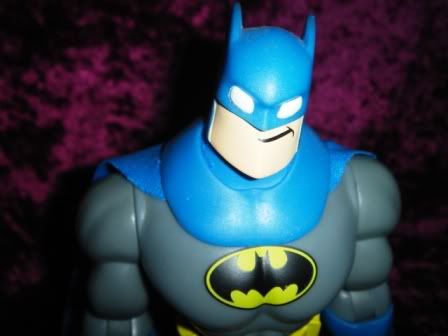
RAGE!! Because sculpted, plastic and filled with joy never caught on.

I think Leitch's argument, while thoughtful, is flawed on several counts.

For one, I object to his definition of antihero. I don't think it's "wrong," it's just not very accurate or useful in this context. Antiheroism is relative to the values of the community being represented. Wayne might be bitter and Stark's an alcoholic, but they still embrace traditional superhero values. They seek noble ends like justice and redemption. And while they push boundaries, they rarely step outside them.

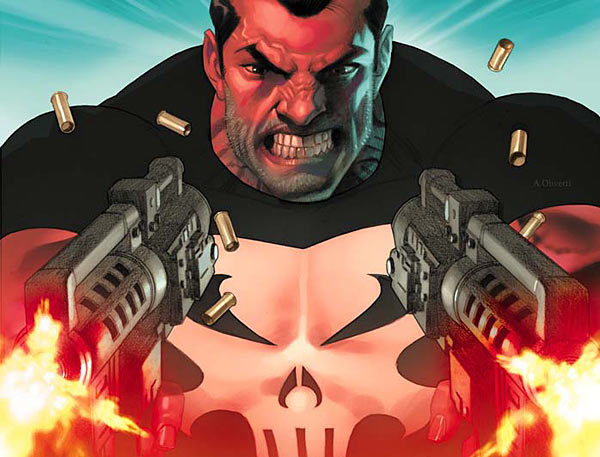
If you want a more accurate representation of antiheroes, I'd look to the Punisher and Deadpool. Punisher works outside the boundaries and Deadpool doesn't even acknowledge them. Anger, guilt and womanizing hardly compare to unrelenting homicide and madness. If they're all lumped together under the heading of "antihero," the terminology is taxed to the point of irrelevance.

"Tony didn't say anything about a cover charge!!!"

If Mr. Leitch means only to say that we like flawed heroes, that's been true at least as far back as Moses, and it was equally true of Christopher Reeve's Superman. His motives, while pure, are still mixed. He rebelled against his father's commandment not to reverse time because of his obsessive devotion to Lois, then turned his back on humanity for the same reason in the second film. This doesn't make him bad by any stretch of the imagination, but it does highlight how we tend to pass over Superman's flaws even when they're as pronounced as Batman's.

Leitch goes even further:

Superman is, by his very design, perfect and cheesy - he's a relic, Ward Cleaver in a blue skintight suit.

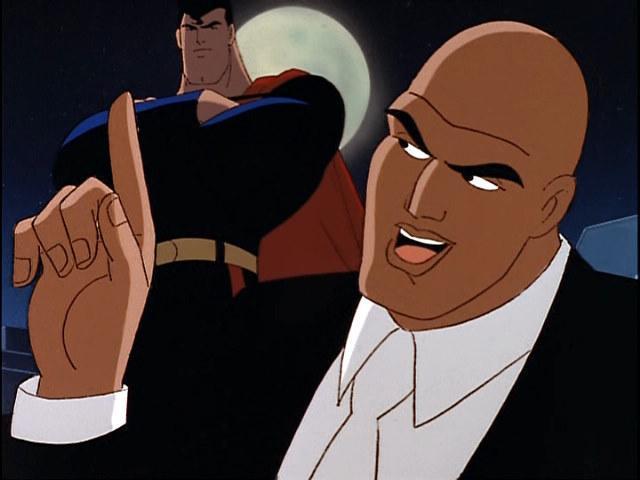
"Golly, Lex, I don't know. How can we hold Metropolis hostage when we promised Superman we'd do our homework?"
 I think Leitch is confusing perfection and idealism. Perfection is essentially completion or fulfillment. Saying we can attain perfection (Idealism) isn't the same as being perfect. By that same token, Superman can't be perfect until we're perfect, because he exists to remind us we have a destiny. Yet Veitch's Superman seems indelibly linked to the past rather than the future:
Singer attempted to capture that naïveté and bring it to today, but his Metropolis seemed as steeped in the '50s as the Steve Reeves films were. The reason the first two "Superman" films worked was that they were rooted in a recognizable place: Metropolis was late-'70s New York City, with all the grime and cynicism that came with it. Superman was an alien (he's the one who was out of place), an actual hero here to save the day, to give everyone faith again. To believe a man can fly, you must at first believe a man cannot.

I'm agreed with Veitch that Superman's faith in humanity is the root of his alienation. That's why Superman ultimately comes into conflict with Luthor, who sees Metropolis and humanity as mere extensions of himself. If Superman were half the relic Veitch thinks him, Luthor wouldn't feel so threatened. But Luthor understands what even Metropolis can't, because he fears it. Luthor has always believed a man can fly, which is why he devotes himself to clipping humanity's wings. And he knows where Superman really hails from: the future.


Lex Luthor just became irrelevant.
One of my favorite lines from Macbeth is, "Your letters have transported me beyond this ignorant present, and I now feel the future in the instant." Superman is Lex Luthor's window into a future where power struggles are obsolete. Lady Macbeth goes mad because she cannot help but bring the future to pass; Luthor because he cannot hold it back.

If Snyder wants to make Superman work, I think he needs to tap into "The Man of Tomorrow" vibe. That's been critical to most incarnations of Superman, but the one we're most familiar with is Donner's. His Superman can't be with Lois because it's still Today, which makes their relationship tragic and uplifting all at once. It's a metaphor for where humanity finds itself now, where we've always found ourselves, somewhere between the Fall and Redemption, Impossibility and Infinity.

When the time comes to bridge that gap in Hollywood...

Tuesday, October 5, 2010

$#*! My Dad Worked On Last Week

The second episode of $#*! My Dad Says , "Wi-Fight," is showing signs of improvement, but there's still a lot of work to be done.

They took one step toward correcting the show's biggest problem, which is its reliance on Shatner to carry every scene. Will Sasso (Vince) and Nicole Sullivan (Bonnie) had more script to work with this week, as Ed's blunt way of putting things carried over into their bedroom. Vince convinces Bonnie to let his dad examine her breasts when she develops a rash. Ed makes the mistake of casually describing the culprit, a fungal infection, as looking like "spaghetti and meatballs under a microscope" to his son Vince. This leads to a relatively funny scene where Bonnie makes advances and Vince tries to get around his breast/fungus/meatballs hangup.

It's not the most ingenious concept or even the best execution, but it accomplishes a few things. First off, it establishes how the $#*! Ed says actually has bearing on his family even when he's not in the room. If the show is going to work, Ed's words should be as much of a character as Ed himself. This was absolutely a step in the right direction.

Second, it gives Sasso and Sullivan a chance to establish chemistry, which they pull off pretty well. Maybe a little too well, in fact, if the rest of the show can't keep pace. Compared to Jonathan Sadowski's uninspired performance, it makes one wonder if the show couldn't be about them living under Ed's roof and dispense with Henry altogether.

"Who's Henry?"
And that brings us to some of the continuing problems. The fact I'm talking about the fungus subplot and not the "Wi-Fight" the episode gets its name from shows just how uneven the show can be. Ed's most memorable interaction in the pilot episode wasn't with his children, but rather the unnamed DMV character. The good news is the DMV character is set to return this week.

So what's really going to need to happen to take the show to the next level? Sadowski needs to find his voice. The producers would have been better off if Sasso and Sullivan were the weak link, seeing as how the show's crux is Henry's relationship with Ed. So far, Sadowski hasn't illustrated the comedic timing or emotional depth the show needs.


"Dad, my back hurts. Can you carry the show tonight?"

That said, Sadowski's material isn't exploring his character's potential to its fullest. For instance, the script seems to call for a pretty bland relationship with half-brother Vince. I tend to think that Henry, unemployed and trying to make up for the life he didn't have with his father, would be a tad jealous of Vince, who lived with Ed growing up, and is now successful and married.

So all in all, not a bad week, and reason to keep watching. But the producers need to look into ways to make Henry work.